


Daily
Current Affairs Analysis
17 october
2024
-------------------------------------------------------------------------------------------------------------
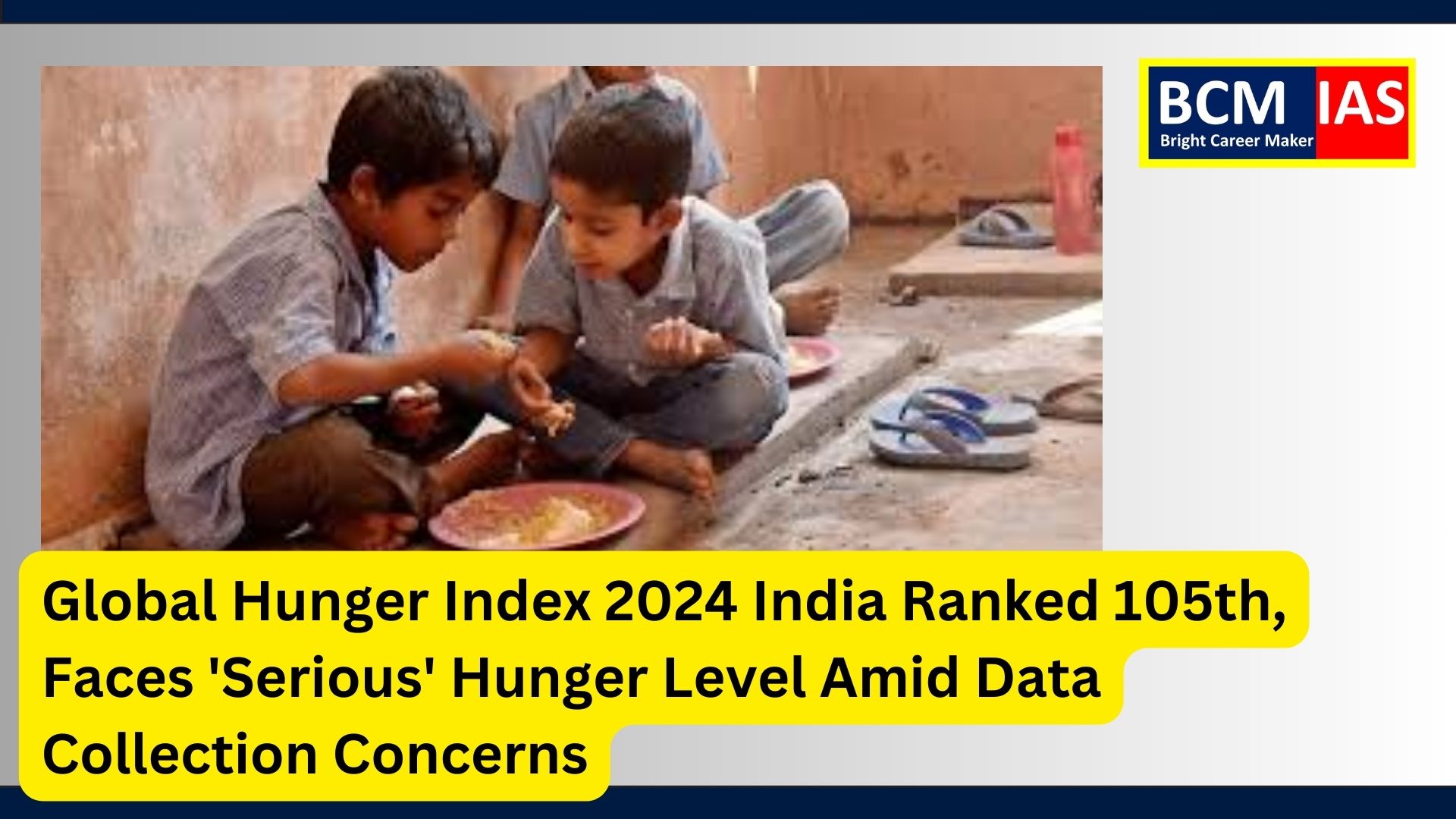
"Global Hunger Index 2024: India Ranked 105th,
Faces 'Serious' Hunger Level Amid Data Collection Concerns"
News Explanation
The article discusses India's position in
the Global Hunger Index (GHI) 2024, its implications, and the debate
surrounding the data collection methods used for the index. India has been
ranked 105th out of 127 countries, indicating a "serious" level of
hunger, with specific concerns raised by the Ministry of Women and Child
Development regarding the data's accuracy.
Key Points:
1. India’s Position in the
Global Hunger Index 2024:
o
India has been ranked 105th out of 127 countries, with
a score of 27.3, which places it in the "serious" category for
hunger.
o
The GHI uses a scale where a score below 9.9 indicates
low hunger, 10-19.9 is moderate, 20-34.9 is serious, 35-49.9 is alarming, and
above 50 is extremely alarming.
2. Indicators Used for the
GHI:
o
The index is based on four key parameters:
1. Child Stunting: The share of children under five with
lower height for their age, reflecting chronic undernutrition.
2. Undernourishment: The proportion of the population with
insufficient caloric intake.
3. Child Wasting: The share of children under five with
lower weight for their height, indicating acute malnutrition.
4. Child Mortality: The proportion of children who die before
their fifth birthday.
o
The report notes that 13.7% of India's population is
undernourished, 35.5% of children under five are stunted, 18.7% are wasted, and
2.9% die before reaching the age of five. India also records the highest child
wasting rate globally.
3. Government Initiatives
Highlighted:
o
Despite the concerning statistics, the report
acknowledges that India has demonstrated political will to address food and
nutritional security.
o
Initiatives such as the National Food Security Act,
Poshan Abhiyan (National Nutrition Mission), PM Garib Kalyan Yojna (PMGKAY),
and the National Mission for Natural Farming are cited as efforts to transform
the food and nutrition landscape.
o
However, the report emphasizes the need for continued
improvement, particularly in addressing social and economic inequalities that
contribute to malnutrition.
4. Issues with Data
Collection and Accuracy:
o
The Ministry of Women and Child Development has raised
concerns over the data collection methods used in the GHI. It pointed out that
the index data does not utilize information from India's ICT-based "Poshan
Tracker," an application used to monitor nutritional outcomes across the
country.
o
The Ministry argued that using survey estimates
instead of data from recognized platforms like the Poshan Tracker could
compromise accuracy. It claimed that the tracker shows child wasting rates
below 7.2%, significantly lower than the 18.7% reported by the GHI.
5. Proposed Solutions to
Address Hunger and Malnutrition:
o
The GHI report advocates for a multifaceted approach
to combat hunger, suggesting improvements in access to social safety nets and
complementary factors like water, sanitation, and hygiene.
o
It emphasizes the importance of investments in mother
and child health and calls for a more holistic food system that promotes
diversified, nutritious, and ecologically friendly food production, including
the use of millets and other nutrient-rich crops.
o
There is also a call for policies that address the
link between nutrition, gender, and climate change to create more sustainable
solutions.
6. Debate on Economic
Growth and Nutrition:
o
The report highlights that economic growth alone does
not guarantee better nutritional outcomes, pointing out that the correlation
between GDP growth and reduced hunger levels is not always direct. It stresses
the need for pro-poor development policies that address structural
inequalities.
Analysis:
India's ranking in the Global Hunger Index
2024 has brought attention to ongoing challenges in food security and child
nutrition. Despite various government schemes aimed at improving these aspects,
the high levels of child stunting and wasting suggest deeper structural issues.
The discrepancies between data sources (GHI vs. Poshan Tracker) have sparked
debates about the accuracy and reliability of international indices,
highlighting the need for standardized and comprehensive data collection.
The GHI's emphasis on child wasting is
particularly concerning, as it indicates acute malnutrition that could lead to
long-term developmental issues. While government programs like Poshan Abhiyan
and PMGKAY have been beneficial, more targeted efforts are needed to address
regional disparities and ensure the effectiveness of these schemes at the
grassroots level.
Conclusion:
The Global Hunger Index 2024 raises
important questions about hunger and malnutrition in India. While progress has
been made through various government initiatives, the serious ranking points to
the need for more comprehensive strategies and accurate data collection.
Addressing malnutrition will require continued political commitment, holistic
approaches to food security, and policies that target the root causes of
poverty and inequality. Collaboration between government bodies, international
organizations, and local communities will be essential to create lasting
solutions.
Mains Probable Question
"Critically
examine India's ranking in the Global Hunger Index 2024. What factors contribute
to the country's 'serious' level of hunger, and how has the government
responded to concerns raised about data collection methods?"
Model Answer
Introduction:
India was
ranked 105th out of 127 countries in the Global Hunger Index (GHI) 2024, with a
score of 27.3, indicating a "serious" level of hunger. The GHI uses
parameters such as child stunting, undernourishment, child wasting, and child
mortality to measure hunger. India's ranking has raised concerns about the
state of food and nutritional security, as well as questions regarding the
accuracy of data collection.
Factors
Contributing to India's 'Serious' Hunger Level:
1. High Rates of Child Stunting and Wasting:
o
According to the GHI 2024,
35.5% of children under five in India are stunted (low height for age),
reflecting chronic undernutrition. Additionally, 18.7% are wasted (low weight
for height), indicating acute malnutrition.
o
India has the highest rate of
child wasting globally, a situation that points to significant issues in child
health, nutrition, and the effectiveness of existing welfare programs.
2. Undernourishment:
o
The report notes that 13.7% of
India’s population is undernourished, meaning they do not have access to
sufficient caloric intake. This reflects broader socio-economic challenges,
including poverty, food distribution inefficiencies, and regional disparities.
o
Undernourishment remains a
persistent issue, particularly in rural areas, where access to quality food and
healthcare services is often limited.
3. Child Mortality:
o
The GHI also highlights that
2.9% of children in India die before the age of five. High child mortality
rates are often linked to malnutrition, lack of healthcare, and inadequate
maternal health services.
4. Economic Inequalities and Poor Implementation of Programs:
o
Despite India’s economic
growth, there exists a stark divide between GDP growth and improved food
security. Economic growth alone has not been sufficient to address issues like
poverty and hunger, and the benefits of welfare schemes often fail to reach the
most vulnerable sections of the population.
o
Social and economic
inequalities continue to limit access to nutritious food, clean water,
sanitation, and healthcare, which are crucial for reducing hunger.
Government
Initiatives to Address Hunger:
1. National Food Security Act (NFSA):
o
The NFSA aims to provide
subsidized food grains to approximately two-thirds of India's population. This
law is a key pillar in ensuring food security, particularly for economically
weaker sections.
o
Additionally, schemes like the
Public Distribution System (PDS) are vital in providing affordable food grains
to millions of households.
2. Poshan Abhiyan (National Nutrition Mission):
o
The government has launched
initiatives like the Poshan Abhiyan, which focuses on improving nutrition for
mothers and children. It seeks to address issues of stunting, wasting, and
anemia through targeted interventions.
o
Programs like the PM Garib
Kalyan Yojana (PMGKAY) have provided additional food support during times of
crisis, such as the COVID-19 pandemic.
3. National Mission for Natural Farming and Agriculture Diversification:
o
India is also focusing on
transforming the agricultural landscape through the National Mission for
Natural Farming, which promotes sustainable and diversified farming practices.
o
Encouraging the cultivation of
nutrient-rich crops like millets is a step toward improving the nutritional
content of the food supply.
Debate Over
Data Collection Methods:
1. Concerns Raised by the Ministry of Women and Child Development:
o
The Ministry has expressed
concerns about the data collection methods used in the GHI. It criticized the
index for not utilizing data from India's ICT-based "Poshan Tracker,"
which monitors nutritional outcomes across the country.
o
According to the Ministry, the
Poshan Tracker data indicates child wasting rates below 7.2%, significantly
lower than the 18.7% reported by the GHI. This discrepancy has led to debates
about the reliability and accuracy of the GHI's methodology.
2. Response from International Agencies:
o
Researchers supporting the GHI
methodology argue that they use established survey estimates vetted by
international organizations like UNICEF, WHO, and the World Bank. They maintain
that the data used in the index is based on consistent and comparable global
methodologies, ensuring reliability.
o
The debate underscores the
need for accurate and transparent data collection and reporting to address food
and nutrition challenges effectively.
Conclusion:
India’s
ranking in the Global Hunger Index 2024 reflects persistent issues in food
security and nutrition, despite several government initiatives. The high rates
of child stunting, wasting, and undernourishment highlight the need for
comprehensive and targeted interventions to address the root causes of hunger.
While India has made efforts through various schemes, the impact of these
programs remains limited by socio-economic inequalities and implementation
challenges. Additionally, the debate over data accuracy emphasizes the
importance of reliable metrics in understanding and combating hunger. Moving
forward, India must strengthen its efforts to ensure that food security reaches
the most vulnerable populations, using accurate data to guide policy decisions.
MCQs for Prelims Practice
Question 1:
What is
India's ranking in the Global Hunger Index (GHI) 2024?
1. 85th out of 127 countries
2. 95th out of 127 countries
3. 105th out of 127 countries
4. 115th out of 127 countries
Answer: 3. 105th out
of 127 countries
Explanation: India was
ranked 105th out of 127 countries in the Global Hunger Index 2024, indicating a
"serious" level of hunger based on various indicators of malnutrition
and food insecurity.
Question 2:
Which of the
following indicators is NOT used in calculating the Global Hunger Index?
1. Child Stunting
2. Child Mortality
3. Child Immunization Rate
4. Undernourishment
Answer: 3. Child
Immunization Rate
Explanation: The GHI is
calculated using four indicators: child stunting, child wasting, child
mortality, and undernourishment. Child immunization rate is not one of the
parameters used in this index.
Question 3:
What concerns
did the Ministry of Women and Child Development raise regarding the Global
Hunger Index (GHI) 2024?
1. Lack of government funding for nutrition programs
2. Incorrect data usage that ignored India's Poshan Tracker
3. Overestimation of India's GDP growth
4. Inclusion of child mortality rates
Answer: 2. Incorrect
data usage that ignored India's Poshan Tracker
Explanation: The Ministry
raised concerns about the GHI not using data from India's "Poshan
Tracker," which is an ICT-based tool for monitoring nutritional outcomes.
The Ministry argued that this led to discrepancies, especially in the reported
child wasting rates.
Question 4:
Which
government program focuses on improving maternal and child nutrition in India?
1. Swachh Bharat Mission
2. National Rural Employment Guarantee Scheme (NREGS)
3. Poshan Abhiyan (National Nutrition Mission)
4. Atal Pension Yojana
Answer: 3. Poshan
Abhiyan (National Nutrition Mission)
Explanation: Poshan
Abhiyan, also known as the National Nutrition Mission, is aimed at improving
the nutritional status of mothers and children by addressing issues like
stunting, wasting, and anemia.
Question 5:
According to
the Global Hunger Index 2024, which form of malnutrition does India have the
highest rate globally?
1. Child Stunting
2. Child Wasting
3. Child Mortality
4. Adult Undernourishment
Answer: 2. Child
Wasting
Explanation: India has
the highest rate of child wasting in the world, according to the Global Hunger
Index 2024. Child wasting indicates acute malnutrition and is a serious concern
for child health and development.


Comments on “"Global Hunger Index 2024: India Ranked 105th, Faces 'Serious' Hunger Level Amid Data Collection Concerns"”